Showing posts with label science. Show all posts

Thursday, December 9, 2010

Congratulations SpaceX!! - Images & Video from COTS 1 Demo

Congratulations again to SpaceX for their successful demonstration mission yesterday!  The Falcon 9 and Dragon vehicles performed admirably.

My first post yesterday covered their successful launch and achievement of orbit with the Dragon crew/cargo capsule.  My second post yesterday covered their successful re-entry.

Here are some more images to continue the celebration.
Dragon with parachutes deployed
Recovery boat approaches Dragon
High Res of the Falcon 9 launch by NASA
High Res of launch by Parabolic Arc
High Res of launch by Florida Today

Youtube has some great video of the launch as well, here are some good selections:
  • Link 1 - HD coverage from NASA TV of the launch (no onboard video) 
  • Link 2 - Original SpaceX webcast footage of launch (with onboard video)
  • Link 3 - Post Mission interview with Elon Musk (55min long)
 

Wednesday, December 8, 2010

Congratulations SpaceX!! - COTS Demo of Dragon is SUCCESSFUL!

Congratulations to SpaceX for a successful demonstration today of the Falcon 9 launch vehicle and the Dragon crew/cargo capsule!!  Way to kick some serious ass!!

Earlier today I made a post on their successful launch, separation, and initiation of orbit. 
Launch today at KSC of Falcon 9 with Dragon by SpaceX

Around 10:30am EST SpaceX launched the Falcon 9 launch vehicle with a Dragon crew/cargo capsule on it from Kennedy Space Center in Florida.  After reaching orbit, Dragon separated from the second stage of the vehicle and proceeded to circle our blue dot (i.e. orbit earth).  For space nerds like myself, watching the SpaceX webcast of these events was cause for mass celebration!
Second stage engine with nose cone falling back to earth

Around 2:30pm EST Dragon did a re-entry burn, entered the atmosphere, deployed parachutes, and splashed down.  SUCCESS! 

This feat made SpaceX the first commercial company EVER to conduct the re-entry of spacecraft from low earth orbit.  Big balls!  :-D

All of this was part of a demonstration SpaceX conducted for NASA and the US Government on a program called "COTS".  Essentially this program is designed to commercial spaceflight to service the International Space Station (ISS).  The immediate goal is to service cargo to and from the ISS, with the strong possibility of rotating crew...eventually. 
Business end of the Falcon 9 with 9 liquid rocket engines

Today's success is a huge milestone for SpaceX and commercial spaceflight in general.  This is a big win for the US, a relatively small company, and the hopes of many that believe commercial spaceflight is the way of the future (at least to low earth orbit aka LEO).  Respect to SpaceX and it's team that made this happen.  Don't forget NASA and the US Government though - they are footing some of the bill here, and essentially creating the "marketplace" by creating contracts for SpaceX (and others, like Orbital Sciences Corp) to service ISS.

All in all, a very good day for space and spaceflight.  Grab a pint, and toast to the stars tonight! 

*note:  I've got some video and other pictures I will add later, please check back tonight or tomorrow for another update!

Congratulations SpaceX!! - Falcon 9 / Dragon Test Flight

Congratulations to SpaceX for the successful COTS demonstration launch today!  HELL YEAH!
Falcon 9 looking sexy on the pad
Today's launch of the Falcon 9 launch vehicle with the Dragon crew/cargo capsule appears to be a huge success.  Launch went well, first stage / second stage separation went well, and the Dragon capsule confirmed separation and powered on it's propulsion systems successfully in orbit.
Today's Falcon 9 launch at Kennedy Space Center, FL
Second stage kicking ass

Damn fine job.  I watched the webcast with great anticipation, as this test had a lot on the line for the US, SpaceX, NASA, and human spaceflight in general.  Very happy to see that it went smoothly.  These screenshots are from that webcast.  (www.spacex.com/webcast.php
Dragon capsule separates and starts to kick ass on its own

All that is left now are a few orbits around the earth, re-entry (not trivial), and recovery (and inspection). 

Dragon capsule can carry cargo and crew to LEO
Will be looking forward to additional updates on their COTS demonstration mission as it becomes available.  I might post more, as information and images trickle in from various sources.

Sunday, November 14, 2010

A Map of Your Galaxy - The Milky Way

Understanding our galaxy, "The Milky Way."  An exercise that will expand your mind. 

I've got a future post planned for some Hubble Space Telescope wallpapers...my favorites, to be exact.  But before I get to that, I figure you need to put some context around what you are seeing, hence the galaxy and the map.   
(note:  click images for larger view)

Too many times people look at the Hubble pictures and go, "oh, that's cool" without even the slightest understanding of what they are actually viewing.  HST has given us a window into the galaxy mankind has never had before.  I want to try and bring that home by introducing you to a map of our galaxy.

That leads us to quick discussion on our galaxy, also known as the "Milky Way".  The Milky Way is the galaxy in which the "Solar System" is located.  The Solar System is our sun and anything drawn to the sun by the forces of gravity.

For those of you who slept through these classes (its alright, I skipped a lot myself...), I have some numbers for you:
  • 1 light year = about 6 trillion miles
  • Our galaxy has a total diameter of approximately 100,000 light years
  • Our sun is about 26,000 light years from the central "bulge" of the galaxy
  • It takes 200-250 million years for the sun to complete one orbit around that central "bulge"
  • Surrounding the galaxy, there are approx 200 globular clusters, containing 1 million stars each
  • Our galaxy contains roughly 200 billion stars 

This is your Milky Way galaxy.  This is the galaxy that contains our sun, and our pale blue dot - earth.  Looks pretty phenomenal eh?  That scale in the lower left is 10,000 light years.  You can use the numbers from above to do a little math on the size of our galaxy.  100,000 light years x 6 trillion miles = 600 quadrillion miles!  (hint, quadrillion comes after trillion, and looks like this:  600,000,000,000,000,000)

That's a good image, but it's top-down, 2D.  That's not how space works, so here is a side view, to give some depth and an understanding of the 3D nature of the beast...so to speak.  A side view will also give you some idea of the "bulge" (aka nucleus), the globular clusters, and the various "arms"...as well as the approximate position of our sun on one of those arms.

Here is another side view that highlights our location in the galaxy, aka our solar system.  In the above image you see the "local arm", obviously containing our sun.  This tilted image does a little bit better job of bringing it home when you think about "you are here" (sort of like the mall map when you need to find the food court).

Alright, your mind should be sufficiently blown at this moment.  You may also be asking yourself - wait, what's all this about the "universe"?  Well a universe is a collection of galaxies.  The Milky Way is one of the hundreds of billions of observable galaxies in what is traditionally known as the "observable universe".  So take these numbers and start doing this with them n^n (n raised to the n).  If your mind wasn't blown before, it should be ass-ploded by now.  And oh, yes, there is a reason for the word "observable" in "observable universe".  It implies that we know, but are not able to fully observe outside of this universe...in other words, we think we see our tip of the iceberg.  Understanding the numbers from above, and the sheer size of that "iceberg tip",  it should be clear that the possibilities are infinite.  So infinite that even if we could put numbers on it, they wouldn't mean anything to us, as it would be larger and more complex than anything we could understand.

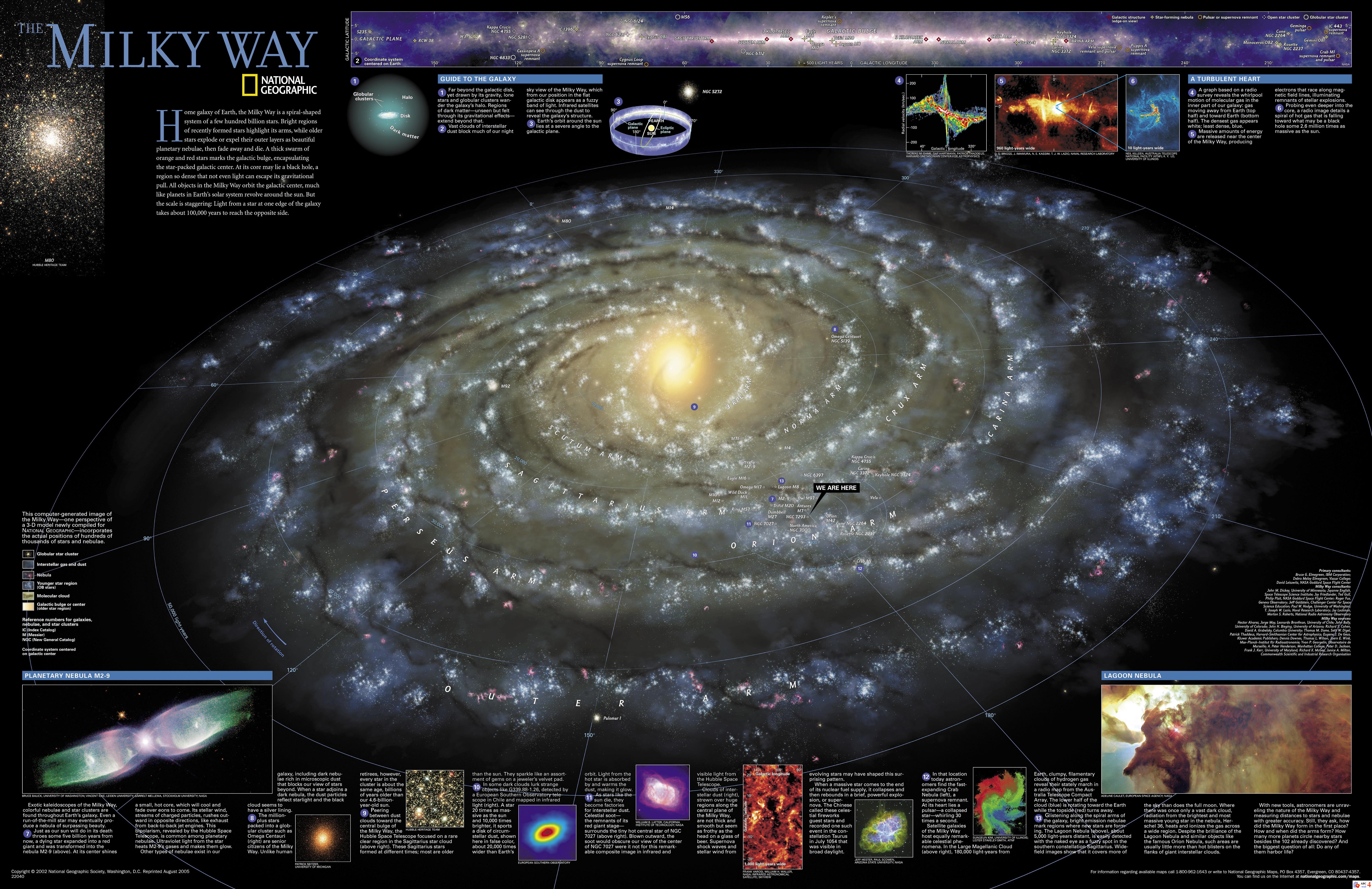
To wrap up, here is an absolutely amazing map of our galaxy provided by National Geographic.  This has more information on it than any of the above pictures, but wouldn't make any sense if you didn't think about the numbers and the context.  Still, our feeble human minds have difficulty grasping the sheer size of our galaxy, let alone the possibilities that exist in the universe.  It also has a rocking "You are Here" label to make you feel really, really small.  Leave it to Nat Geo to make a poster like this one, god I love those people.  Click for high resolution!  (larger original is here

note:  on this day, in 1971, NASA's spacecraft 'Mariner 9' reached Mars, and became the first object to orbit another planet! let's keep kicking ass, pushing the envelope, and going further, and further away from "home".