Showing posts with label nasa. Show all posts

Thursday, December 9, 2010

Congratulations SpaceX!! - Images & Video from COTS 1 Demo

Congratulations again to SpaceX for their successful demonstration mission yesterday!  The Falcon 9 and Dragon vehicles performed admirably.

My first post yesterday covered their successful launch and achievement of orbit with the Dragon crew/cargo capsule.  My second post yesterday covered their successful re-entry.

Here are some more images to continue the celebration.
Dragon with parachutes deployed
Recovery boat approaches Dragon
High Res of the Falcon 9 launch by NASA
High Res of launch by Parabolic Arc
High Res of launch by Florida Today

Youtube has some great video of the launch as well, here are some good selections:
  • Link 1 - HD coverage from NASA TV of the launch (no onboard video) 
  • Link 2 - Original SpaceX webcast footage of launch (with onboard video)
  • Link 3 - Post Mission interview with Elon Musk (55min long)
 

Wednesday, December 8, 2010

Congratulations SpaceX!! - COTS Demo of Dragon is SUCCESSFUL!

Congratulations to SpaceX for a successful demonstration today of the Falcon 9 launch vehicle and the Dragon crew/cargo capsule!!  Way to kick some serious ass!!

Earlier today I made a post on their successful launch, separation, and initiation of orbit. 
Launch today at KSC of Falcon 9 with Dragon by SpaceX

Around 10:30am EST SpaceX launched the Falcon 9 launch vehicle with a Dragon crew/cargo capsule on it from Kennedy Space Center in Florida.  After reaching orbit, Dragon separated from the second stage of the vehicle and proceeded to circle our blue dot (i.e. orbit earth).  For space nerds like myself, watching the SpaceX webcast of these events was cause for mass celebration!
Second stage engine with nose cone falling back to earth

Around 2:30pm EST Dragon did a re-entry burn, entered the atmosphere, deployed parachutes, and splashed down.  SUCCESS! 

This feat made SpaceX the first commercial company EVER to conduct the re-entry of spacecraft from low earth orbit.  Big balls!  :-D

All of this was part of a demonstration SpaceX conducted for NASA and the US Government on a program called "COTS".  Essentially this program is designed to commercial spaceflight to service the International Space Station (ISS).  The immediate goal is to service cargo to and from the ISS, with the strong possibility of rotating crew...eventually. 
Business end of the Falcon 9 with 9 liquid rocket engines

Today's success is a huge milestone for SpaceX and commercial spaceflight in general.  This is a big win for the US, a relatively small company, and the hopes of many that believe commercial spaceflight is the way of the future (at least to low earth orbit aka LEO).  Respect to SpaceX and it's team that made this happen.  Don't forget NASA and the US Government though - they are footing some of the bill here, and essentially creating the "marketplace" by creating contracts for SpaceX (and others, like Orbital Sciences Corp) to service ISS.

All in all, a very good day for space and spaceflight.  Grab a pint, and toast to the stars tonight! 

*note:  I've got some video and other pictures I will add later, please check back tonight or tomorrow for another update!

Congratulations SpaceX!! - Falcon 9 / Dragon Test Flight

Congratulations to SpaceX for the successful COTS demonstration launch today!  HELL YEAH!
Falcon 9 looking sexy on the pad
Today's launch of the Falcon 9 launch vehicle with the Dragon crew/cargo capsule appears to be a huge success.  Launch went well, first stage / second stage separation went well, and the Dragon capsule confirmed separation and powered on it's propulsion systems successfully in orbit.
Today's Falcon 9 launch at Kennedy Space Center, FL
Second stage kicking ass

Damn fine job.  I watched the webcast with great anticipation, as this test had a lot on the line for the US, SpaceX, NASA, and human spaceflight in general.  Very happy to see that it went smoothly.  These screenshots are from that webcast.  (www.spacex.com/webcast.php
Dragon capsule separates and starts to kick ass on its own

All that is left now are a few orbits around the earth, re-entry (not trivial), and recovery (and inspection). 

Dragon capsule can carry cargo and crew to LEO
Will be looking forward to additional updates on their COTS demonstration mission as it becomes available.  I might post more, as information and images trickle in from various sources.

Wednesday, November 17, 2010

Hubble Space Telescope - Best Images for Desktop Wallpaper (Part 1)

I love space.  Space is the shit.  It is the end all be all of everything.  If you think creatures in the deep-blue are crazy, think back to your basic math and statistics, apply it to the galaxy (and then universe), and well...you get my drift.  Folks, it is mathematically impossible that space is empty.  Period.  End of debate.  In case you missed my earlier on post, "A Map of Your Galaxy"...the numbers involved here are enormous.  Our minds can not even comprehend the vastness that is "space".   The numbers are too large, it is literally meaningless to our feeble brains.  Does not compute...

Perhaps one of the coolest pieces of hardware man has ever created is the Hubble Space Telescope, or HST for short.  It has given us some of the most amazing and mind-blowing images humanity ever seen. (high res: closeup shot and the hardware in orbit!)

This post is dedicated to that lovely piece of hardware, and it will show my Top 5 images fit for desktop wallpapers.  I will then follow this post up with another Top 5...for a whopping total of 10!  Yes, I will try to encapsulate all of the many wonderous images HST has brought us into two posts of ten images...sad, when you consider my earlier statement about numbers...

Where possible, I will link directly to the official source (ESA/NASA/Hubble).  We all love wallpapers, and that will be a goal here - badass wallpapers that knock your socks off.  The small versions of the pictures just don't cut it, so make sure you click on all the images, and visit the links for the real view!  Links will be provided for each image so that you can get ultra-high-res to suit your desktop needs.  All credit for the images go to NASA/ESA/Hubble teams.    

If you like what you see here, then I encourage you to support space exploration.  I won't get into the debate of how, when, costs, or schedules.  I just want you to support it.  Don't talk shit, support it.  Space exploration and space travel is the most difficult challenge humankind can attempt.  I do not foresee that changing anytime soon.  RESPECT that challenge, whether you support the agency, it's goals, or it's hardware choices - I ask you only to pay homage to those men and women who have worked so hard for so long, to bring space into your home, for your very own eyes.

Orion Nebula - Few cosmic vistas excite the imagination like the Orion Nebula. Also known as M42, the nebula's glowing gas surrounds hot young stars at the edge of an immense interstellar molecular cloud only 1,500 light-years away. The Orion Nebula offers one of the best opportunities to study how stars are born partly because it is the nearest large star-forming region, but also because the nebula's energetic stars have blown away obscuring gas and dust clouds that would otherwise block our view - providing an intimate look at a range of ongoing stages of starbirth and evolution. This detailed image of the Orion Nebula is the sharpest ever, constructed using data from the Hubble Space Telescope's Advanced Camera for Surveys and the European Southern Observatory's La Silla 2.2 meter telescope. The mosaic contains a billion pixels at full resolution and reveals about 3,000 stars.


"Mystic Mountain" - This craggy fantasy mountaintop enshrouded by wispy clouds looks like a bizarre landscape from Tolkien’s The Lord of the Rings. The NASA/ESA Hubble Space Telescope image, which is even more dramatic than fiction, captures the chaotic activity atop a pillar of gas and dust, three light-years tall, which is being eaten away by the brilliant light from nearby bright stars. The pillar is also being assaulted from within, as infant stars buried inside it fire off jets of gas that can be seen streaming from towering peaks.  This turbulent cosmic pinnacle lies within a tempestuous stellar nursery called the Carina Nebula, located 7500 light-years away in the southern constellation of Carina. The image celebrates the 20th anniversary of Hubble's launch and deployment into an orbit around the Earth.

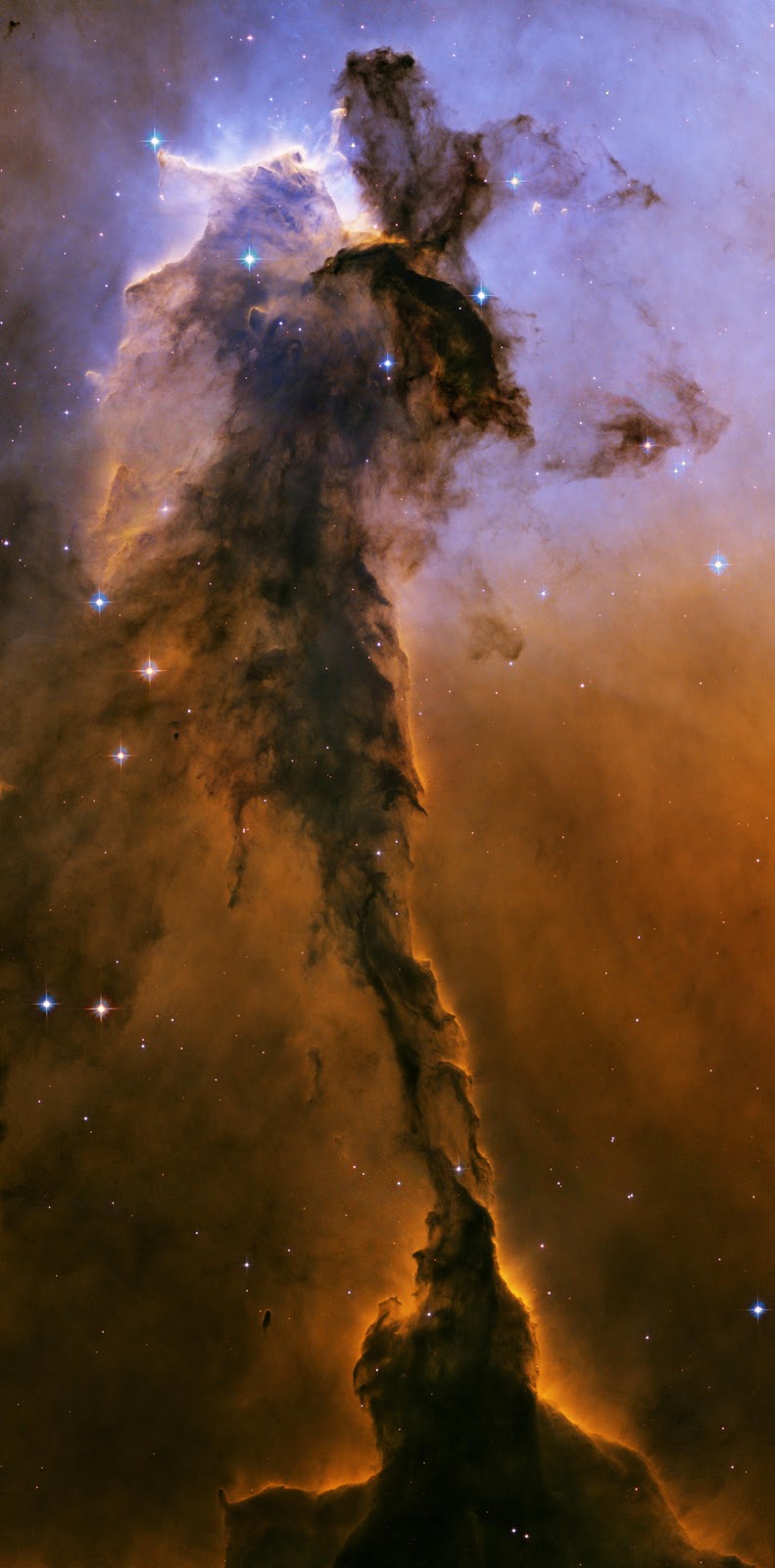
Spire in Eagle Nebula - Appearing like a winged fairy-tale creature poised on a pedestal, this object is actually a billowing tower of cold gas and dust rising from a stellar nursery called the Eagle Nebula. The soaring tower is 9.5 light-years or about 90 trillion kilometres high, about twice the distance from our Sun to the next nearest star.  Stars in the Eagle Nebula are born in clouds of cold hydrogen gas that reside in chaotic neighbourhoods, where energy from young stars sculpts fantasy-like landscapes in the gas. The tower may be a giant incubator for those newborn stars. A torrent of ultraviolet light from a band of massive, hot, young stars [off the top of the image] is eroding the pillar.  Since this one is verticla, it probably doesn't make a great wallpaper, but if you rotate - it works quite well! (due to the vertical nature of this image, it does not scale well for the site, please make sure to visit the link!)

Pinwheel Galaxy (HD!) - This new Hubble image reveals the gigantic Pinwheel galaxy, one of the best known examples of "grand design spirals", and its supergiant star-forming regions in unprecedented detail. The image is the largest and most detailed photo of a spiral galaxy ever taken with Hubble.  The Pinwheel Galaxy (also known as Messier 101 or NGC 5457) is a face-on spiral galaxy distanced 25 million light-years (eight megaparsecs) away in the constellation Ursa Major, first discovered by Pierre Méchain on March 27, 1781, and communicated to Charles Messier who verified its position for inclusion in the Messier Catalogue as one of its final entries.  On February 28, 2006, NASA and the ESA released a very detailed image of Pinwheel Galaxy, which was the largest and most detailed image of a galaxy by Hubble Space Telescope at the time. The image was composed from 51 individual exposures, plus some extra ground-based photos.

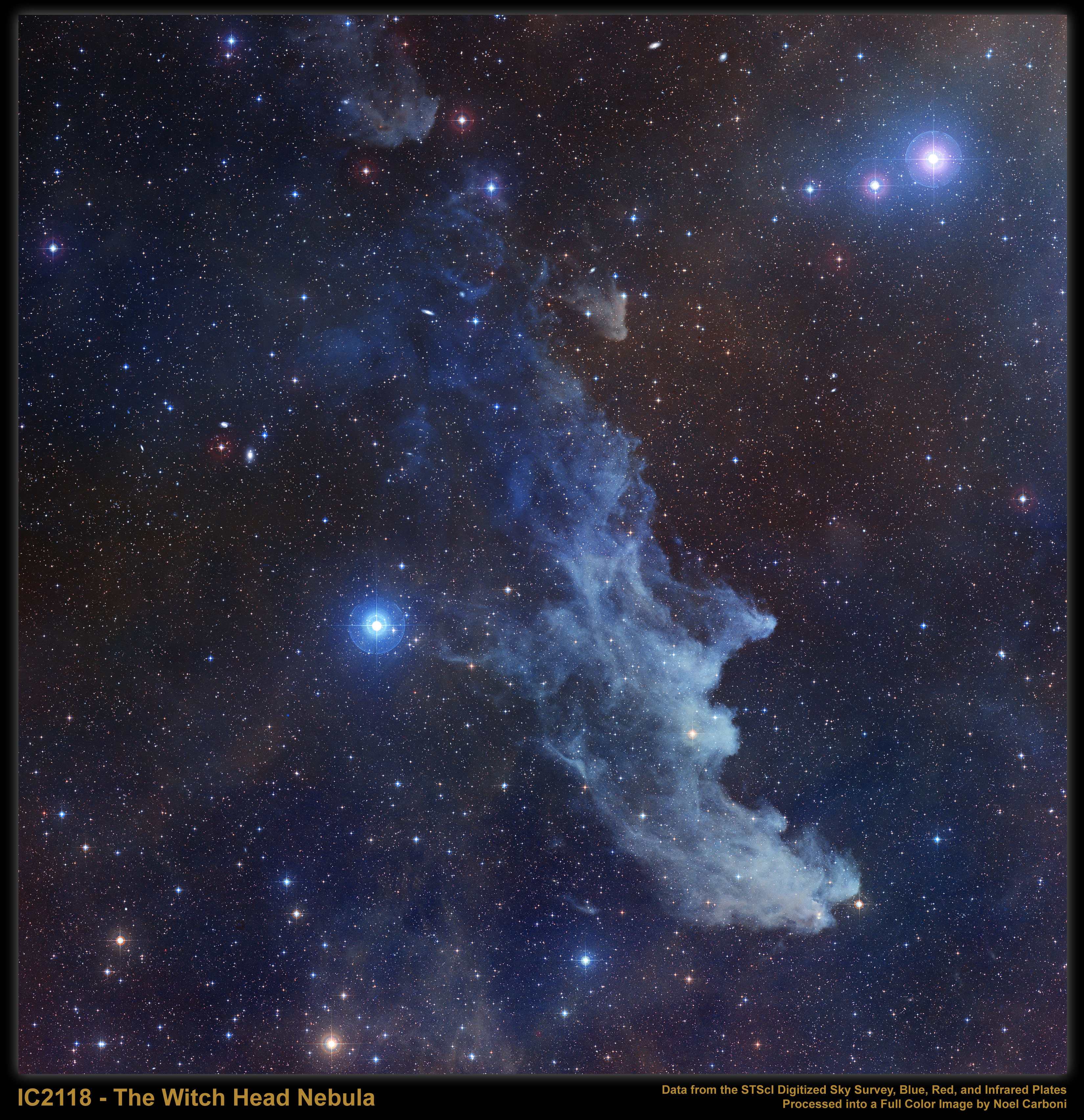
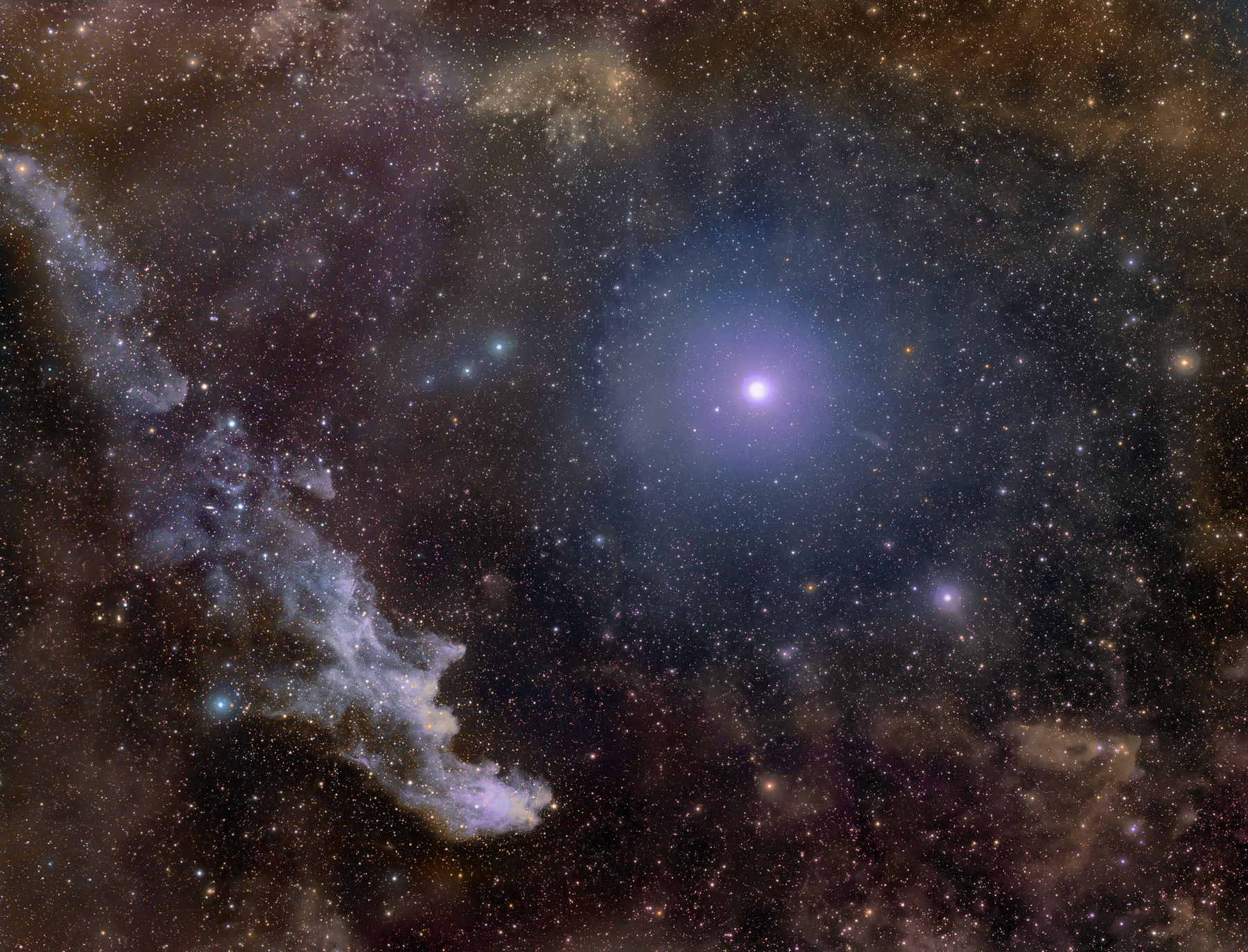
Witchhead Nebula (IC2118) - Double, double toil and trouble; Fire burn, and cauldron bubble -- maybe Macbeth should have consulted the Witch Head Nebula. This suggestively shaped reflection nebula is associated with the bright star Rigel in the constellation Orion. More formally known as IC 2118, the Witch Head Nebula glows primarily by light reflected from bright star Rigel, located just off the upper right edge of the full image. Fine dust in the nebula reflects the light. The blue color is caused not only by Rigel's blue color but because the dust grains reflect blue light more efficiently than red. The same physical process causes Earth's daytime sky to appear blue, although the scatterers in Earth's atmosphere are molecules of nitrogen and oxygen. The nebula lies about 1000 light-years away. (you can find a cropped version here)

Ok, so there are the first 5 images, I hope that you have enjoyed them and at least saved one or two.  Please do browse around spacetelescope.org or hubblesite.org for more wonderful images from Hubble.  Don't forget to check out the 2 high res shots of the hardware as well! 

I will be following this post up with another 5 images soon.  In the meantime, please feel free to tell me which are your favorite images, either from this list, or perhaps something I have missed.  Maybe it will make my next 5! 


Sunday, November 14, 2010

A Map of Your Galaxy - The Milky Way

Understanding our galaxy, "The Milky Way."  An exercise that will expand your mind. 

I've got a future post planned for some Hubble Space Telescope wallpapers...my favorites, to be exact.  But before I get to that, I figure you need to put some context around what you are seeing, hence the galaxy and the map.   
(note:  click images for larger view)

Too many times people look at the Hubble pictures and go, "oh, that's cool" without even the slightest understanding of what they are actually viewing.  HST has given us a window into the galaxy mankind has never had before.  I want to try and bring that home by introducing you to a map of our galaxy.

That leads us to quick discussion on our galaxy, also known as the "Milky Way".  The Milky Way is the galaxy in which the "Solar System" is located.  The Solar System is our sun and anything drawn to the sun by the forces of gravity.

For those of you who slept through these classes (its alright, I skipped a lot myself...), I have some numbers for you:
  • 1 light year = about 6 trillion miles
  • Our galaxy has a total diameter of approximately 100,000 light years
  • Our sun is about 26,000 light years from the central "bulge" of the galaxy
  • It takes 200-250 million years for the sun to complete one orbit around that central "bulge"
  • Surrounding the galaxy, there are approx 200 globular clusters, containing 1 million stars each
  • Our galaxy contains roughly 200 billion stars 

This is your Milky Way galaxy.  This is the galaxy that contains our sun, and our pale blue dot - earth.  Looks pretty phenomenal eh?  That scale in the lower left is 10,000 light years.  You can use the numbers from above to do a little math on the size of our galaxy.  100,000 light years x 6 trillion miles = 600 quadrillion miles!  (hint, quadrillion comes after trillion, and looks like this:  600,000,000,000,000,000)

That's a good image, but it's top-down, 2D.  That's not how space works, so here is a side view, to give some depth and an understanding of the 3D nature of the beast...so to speak.  A side view will also give you some idea of the "bulge" (aka nucleus), the globular clusters, and the various "arms"...as well as the approximate position of our sun on one of those arms.

Here is another side view that highlights our location in the galaxy, aka our solar system.  In the above image you see the "local arm", obviously containing our sun.  This tilted image does a little bit better job of bringing it home when you think about "you are here" (sort of like the mall map when you need to find the food court).

Alright, your mind should be sufficiently blown at this moment.  You may also be asking yourself - wait, what's all this about the "universe"?  Well a universe is a collection of galaxies.  The Milky Way is one of the hundreds of billions of observable galaxies in what is traditionally known as the "observable universe".  So take these numbers and start doing this with them n^n (n raised to the n).  If your mind wasn't blown before, it should be ass-ploded by now.  And oh, yes, there is a reason for the word "observable" in "observable universe".  It implies that we know, but are not able to fully observe outside of this universe...in other words, we think we see our tip of the iceberg.  Understanding the numbers from above, and the sheer size of that "iceberg tip",  it should be clear that the possibilities are infinite.  So infinite that even if we could put numbers on it, they wouldn't mean anything to us, as it would be larger and more complex than anything we could understand.

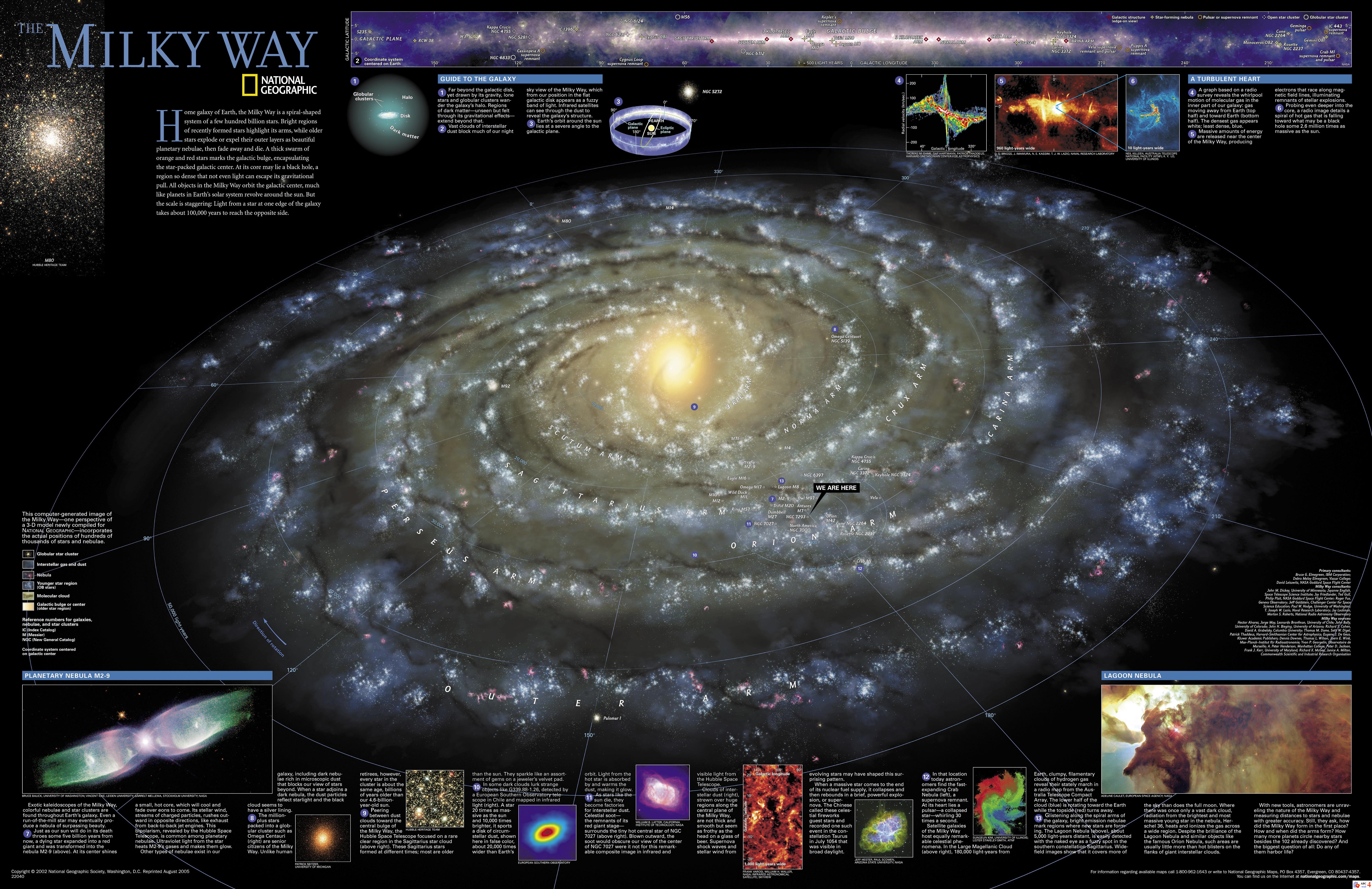
To wrap up, here is an absolutely amazing map of our galaxy provided by National Geographic.  This has more information on it than any of the above pictures, but wouldn't make any sense if you didn't think about the numbers and the context.  Still, our feeble human minds have difficulty grasping the sheer size of our galaxy, let alone the possibilities that exist in the universe.  It also has a rocking "You are Here" label to make you feel really, really small.  Leave it to Nat Geo to make a poster like this one, god I love those people.  Click for high resolution!  (larger original is here

note:  on this day, in 1971, NASA's spacecraft 'Mariner 9' reached Mars, and became the first object to orbit another planet! let's keep kicking ass, pushing the envelope, and going further, and further away from "home".