Showing posts with label wallpaper. Show all posts

Thursday, December 9, 2010

Congratulations SpaceX!! - Images & Video from COTS 1 Demo

Congratulations again to SpaceX for their successful demonstration mission yesterday!  The Falcon 9 and Dragon vehicles performed admirably.

My first post yesterday covered their successful launch and achievement of orbit with the Dragon crew/cargo capsule.  My second post yesterday covered their successful re-entry.

Here are some more images to continue the celebration.
Dragon with parachutes deployed
Recovery boat approaches Dragon
High Res of the Falcon 9 launch by NASA
High Res of launch by Parabolic Arc
High Res of launch by Florida Today

Youtube has some great video of the launch as well, here are some good selections:
  • Link 1 - HD coverage from NASA TV of the launch (no onboard video) 
  • Link 2 - Original SpaceX webcast footage of launch (with onboard video)
  • Link 3 - Post Mission interview with Elon Musk (55min long)
 

Sunday, December 5, 2010

Ten Awesome Android Live Wallpapers - Free for Download

 A selection of 10 awesome Live Wallpapers for your Android phone, all FREE!

Android, unlike the iPhone, has "Live Wallpapers".  Wallpapers that move, play videos, play games, and are interactive.  Below are 10 awesome Android Live Wallpapers that you can download to your phone.  Each live wallpaper is free, and I have provided screenshots for you as well.  Unfortunately I didn't go to the trouble of making .gif's or anything - so the screenshots are static images.  However I try to describe the movement or "live" aspects of each in the description.  A link is provided to the live wallpaper in App Brain so you can download it too. 

Let me know which ones you like and don't like, or if you have any favorites of your own! 

1.  Galactic Core
Very nice live wallpaper of a whirling galaxy that you can tilt and control.  The free version has limited settings, but there is a pay version that gives full control.  Detail and quality of the wallpaper is very good and the live movement is excellent as well.

2.  Pac-Man 
Really cool live wallpaper of the iconic arcade game.  Pac-Man roams the levels avoiding the ghosts and doing what he does best.  The AI is pretty good on this wallpaper, Pac-Man avoids the ghosts, collects points, gets the power-ups and then eats the ghosts.

3.  Substrate
This is a collection of live wallpapers - each with it's own "substrate" flavor.  I highly recommend this live wallpaper for the variety and the customization.  Each live wallpaper comes complete with full settings, even though it's free.  Shown here are Sandollar, Guts, and Sand Traveler.  The live wallpapers are drawn on the screen, detailed, and then repeated.


4.  Flying Toasters
From waaayy back when, the flying toaster returns!  Toasters and toast fly across your screen.  Need I say more?  Nostalgia!

5.  Flurry
The Mac OSX style "Flurry".  For anyone who's ever owned a mac, used a mac, or knows what I'm talking about...this is a live wallpaper version of the Flurry screensaver.  Pretty much a perfect copy of it too.

6.  Galaxy Live
This is another collection of live wallpapers - each a different type of galaxy or nebula.  Although not exactly true to the real stellar phenomenon, each live wallpaper is quite a sight.  There are more than a half dozen to choose from, each various colors and detail.  Movement is pretty much the same amongst them all, but the colors and details provide a nice variety. 


7.  3D Matrix Code
There a lot of Matrix code live wallpapers, and they all pretty much do the same thing - stream Matrix code on your screen.  This one has a slightly different twist by adding a 3D effect.  There is some depth, or distance, to the code that changes its size.  The developer also added some flames, which are actually a nice touch. 

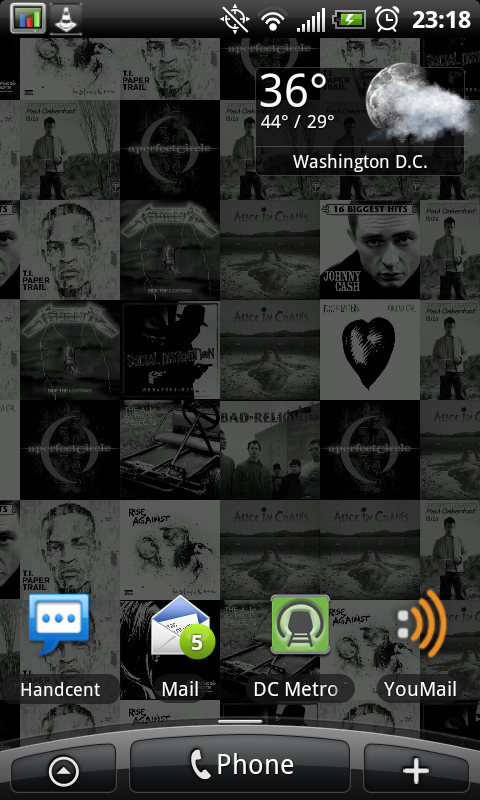
8.  Living Music (Album Art)
This live wallpaper takes your album art and creates a live wallpaper with it.  Album art is randomized and interchanged creating a nice look and feel.  The album art is not colored though, but the overall grey color keeps the screen from feeling cluttered.  There are other version of this same type of live wallpaper, though most of them are paid versions. 

9.  Liquid Particles
A cool live wallpaper that puts colored light particles on your screen that you can interact with.  As you tap the screen the particles fly about until finally coming to rest.  Tap the screen again and they continue to fly.  Do nothing for awhile and they start flying on their own. 

10.  Metal Slug Zombies
Some live wallpapers also double as games.  This one is a take on a fantastic old game - metal slug.  Zombies walk across the screen and you bomb them.  Tap the screen to drop the bomb.  A plane flies in, drops the bomb, and the zombies explode.  There are lots of settings that allow for customization of the background, the zombies, bombs, and other features.  It also keeps track of your score.


There we have it, a top 10 list of free Live Wallpapers for your Android device.  Let me know if you have any suggestions to add to the list! 

Friday, November 26, 2010

Hubble Space Telescope - Best Images for Desktop Wallpaper (Part 2)

Part 2, Finally!  Eight new high-res images perfect for your desktop wallpaper collection.

Sorry for the delay, had to turn in a research paper for work, and then the holidays...you know how it is.  To make up for the delay, I have 8 new images - all of them perfect for desktop wallpaper.  5 are from Hubble, and the last 3 are just awesome "astrophotographs". 

I also have another post coming up on Thanksgiving.  You see my dinner was, well, less than optimal.  *cough* McDonalds *cough* *cough*  :(

Colliding Galaxies 
This Hubble image of the Antennae galaxies is the sharpest yet of this merging pair of galaxies. As the two galaxies smash together, billions of stars are born, mostly in groups and clusters of stars. The brightest and most compact of these are called super star clusters. The Antennae are undergoing a galactic collision. Located in the NGC 4038 group with five other galaxies, these two galaxies are known as the 'Antennae' because the two long tails of stars, gas and dust thrown out of the galaxies as a result of the collision resemble the antennae of an insect.

Butterfly Nebula
What resemble dainty butterfly wings are actually roiling cauldrons of gas heated to nearly 20 000 degrees Celsius. The gas is tearing across space at more than 950 000 kilometres per hour — fast enough to travel from Earth to the Moon in 24 minutes!  A dying star that was once about five times the mass of the Sun is at the centre of this fury. It has ejected its envelope of gases and is now unleashing a stream of ultraviolet radiation that is making the cast-off material glow. This object is an example of a planetary nebula, so-named because many of them have a round appearance resembling that of a planet when viewed through a small telescope.

Heart of the Whirlpool Galaxy
The Whirlpool galaxy, M51, has been one of the most photogenic galaxies in amateur and professional astronomy. Easily photographed and viewed by smaller telescopes, this celestial beauty is studied extensively in a range of wavelengths by large ground- and space-based observatories. This Hubble composite image shows visible starlight as well as light from the emission of glowing hydrogen, which is associated with the most luminous young stars in the spiral arms.

"Ultra Deep Field"
This view of nearly 10,000 galaxies is called the Hubble Ultra Deep Field. The snapshot includes galaxies of various ages, sizes, shapes, and colours. The smallest, reddest galaxies, about 100, may be among the most distant known, existing when the universe was just 800 million years old. The nearest galaxies - the larger, brighter, well-defined spirals and ellipticals - thrived about 1 billion years ago, when the cosmos was 13 billion years old.  The image required 800 exposures taken over the course of 400 Hubble orbits around Earth. The total amount of exposure time was 11.3 days, taken between Sept. 24, 2003 and Jan. 16, 2004.

R136 / RMC136
R136, formally known as RMC 136, is a super star cluster near the center of the 30 Doradus complex (also known as the Tarantula Nebula), in the Large Magellanic Cloud. It is a young star cluster, age 1-2 million years, of giant and supergiant stars. The majority of its stars are of spectral type O3,with 39 confirmed O3-type stars.Additionally, there are several confirmed Wolf-Rayet stars.

Helix Nebula (from Spitzer telescope)
The Helix Nebula, also known as The Helix or NGC 7293, is a large planetary nebula (PN) located in the constellation of Aquarius. Discovered by Karl Ludwig Harding, probably before 1824, this object is one of the closest to the Earth of all the bright planetary nebulae.The estimated distance is about 215 parsecs or 700 light-years. It is similar in appearance to the Ring Nebula, whose size, age, and physical characteristics are similar to the Dumbbell Nebula, varying only in its relative proximity and the appearance from the equatorial viewing angle. The Helix has often been referred to as the Eye of God on the Internet, since about 2003.

NGC 2170 (Nighthawk Observatory)
When stars form, pandemonium reigns. A textbook case is the star forming region NGC 2170. Visible above are red glowing emission nebulas of hydrogen, blue reflection nebulas of dust, dark absorption nebulas of dust, and the stars that formed from them. The first massive stars formed from the dense gas will emit energetic light and winds that erode, fragment, and sculpt their birthplace. And then they explode. The resulting morass is often as beautiful as it is complex. After tens of millions of years, the dust boils away, the gas gets swept away, and all that is left is a naked open cluster of stars.

Colorful Clouds of Rho Ophiuchi
This stunning mosiac of the sky around bright stars Antares (Alpha Scorpii) and Rho Ophiuchi reveals spectacular colors in a cosmic starscape. Near the top, Rho Ophiuchi and nearby stars are immersed in blue reflection nebulae - dust clouds that shine primarily by reflected starlight. Cool supergiant star Antares (lower left) is itself shedding the material that reflects the evolved star's yellowish hue. Characteristic of star forming regions, the telltale red emission from hydrogen gas also permeates the view along with dark, obscuring dust clouds seen in silhouette against the background stars and brighter nebulosities. About 500 light-years away, the Rho Ophiuchi star clouds, are well in front of the nearby globular star cluster M4, visible just below and right of center. The wide view spans about 6 degrees on the sky.

Wednesday, November 17, 2010

Hubble Space Telescope - Best Images for Desktop Wallpaper (Part 1)

I love space.  Space is the shit.  It is the end all be all of everything.  If you think creatures in the deep-blue are crazy, think back to your basic math and statistics, apply it to the galaxy (and then universe), and well...you get my drift.  Folks, it is mathematically impossible that space is empty.  Period.  End of debate.  In case you missed my earlier on post, "A Map of Your Galaxy"...the numbers involved here are enormous.  Our minds can not even comprehend the vastness that is "space".   The numbers are too large, it is literally meaningless to our feeble brains.  Does not compute...

Perhaps one of the coolest pieces of hardware man has ever created is the Hubble Space Telescope, or HST for short.  It has given us some of the most amazing and mind-blowing images humanity ever seen. (high res: closeup shot and the hardware in orbit!)

This post is dedicated to that lovely piece of hardware, and it will show my Top 5 images fit for desktop wallpapers.  I will then follow this post up with another Top 5...for a whopping total of 10!  Yes, I will try to encapsulate all of the many wonderous images HST has brought us into two posts of ten images...sad, when you consider my earlier statement about numbers...

Where possible, I will link directly to the official source (ESA/NASA/Hubble).  We all love wallpapers, and that will be a goal here - badass wallpapers that knock your socks off.  The small versions of the pictures just don't cut it, so make sure you click on all the images, and visit the links for the real view!  Links will be provided for each image so that you can get ultra-high-res to suit your desktop needs.  All credit for the images go to NASA/ESA/Hubble teams.    

If you like what you see here, then I encourage you to support space exploration.  I won't get into the debate of how, when, costs, or schedules.  I just want you to support it.  Don't talk shit, support it.  Space exploration and space travel is the most difficult challenge humankind can attempt.  I do not foresee that changing anytime soon.  RESPECT that challenge, whether you support the agency, it's goals, or it's hardware choices - I ask you only to pay homage to those men and women who have worked so hard for so long, to bring space into your home, for your very own eyes.

Orion Nebula - Few cosmic vistas excite the imagination like the Orion Nebula. Also known as M42, the nebula's glowing gas surrounds hot young stars at the edge of an immense interstellar molecular cloud only 1,500 light-years away. The Orion Nebula offers one of the best opportunities to study how stars are born partly because it is the nearest large star-forming region, but also because the nebula's energetic stars have blown away obscuring gas and dust clouds that would otherwise block our view - providing an intimate look at a range of ongoing stages of starbirth and evolution. This detailed image of the Orion Nebula is the sharpest ever, constructed using data from the Hubble Space Telescope's Advanced Camera for Surveys and the European Southern Observatory's La Silla 2.2 meter telescope. The mosaic contains a billion pixels at full resolution and reveals about 3,000 stars.


"Mystic Mountain" - This craggy fantasy mountaintop enshrouded by wispy clouds looks like a bizarre landscape from Tolkien’s The Lord of the Rings. The NASA/ESA Hubble Space Telescope image, which is even more dramatic than fiction, captures the chaotic activity atop a pillar of gas and dust, three light-years tall, which is being eaten away by the brilliant light from nearby bright stars. The pillar is also being assaulted from within, as infant stars buried inside it fire off jets of gas that can be seen streaming from towering peaks.  This turbulent cosmic pinnacle lies within a tempestuous stellar nursery called the Carina Nebula, located 7500 light-years away in the southern constellation of Carina. The image celebrates the 20th anniversary of Hubble's launch and deployment into an orbit around the Earth.

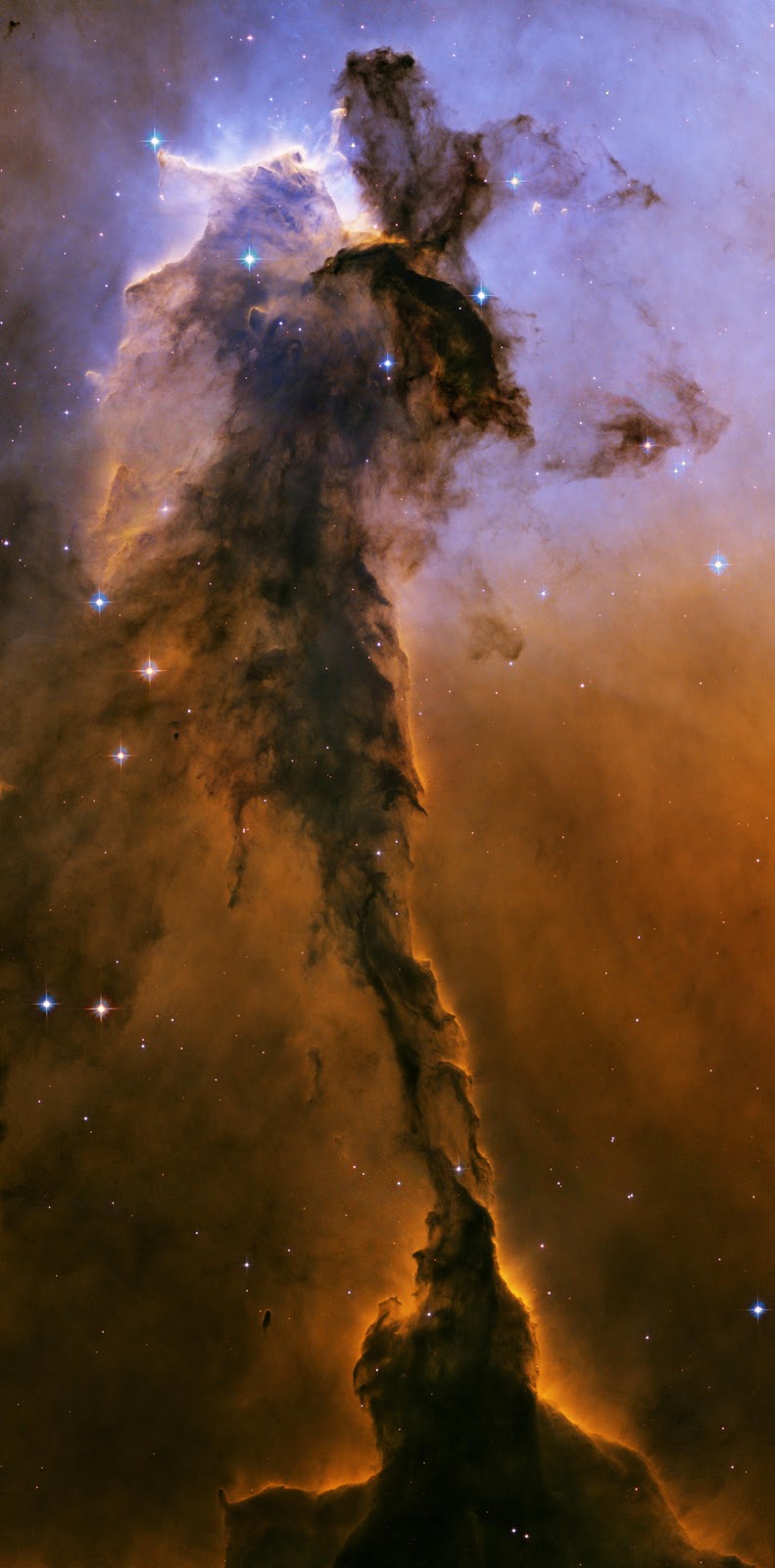
Spire in Eagle Nebula - Appearing like a winged fairy-tale creature poised on a pedestal, this object is actually a billowing tower of cold gas and dust rising from a stellar nursery called the Eagle Nebula. The soaring tower is 9.5 light-years or about 90 trillion kilometres high, about twice the distance from our Sun to the next nearest star.  Stars in the Eagle Nebula are born in clouds of cold hydrogen gas that reside in chaotic neighbourhoods, where energy from young stars sculpts fantasy-like landscapes in the gas. The tower may be a giant incubator for those newborn stars. A torrent of ultraviolet light from a band of massive, hot, young stars [off the top of the image] is eroding the pillar.  Since this one is verticla, it probably doesn't make a great wallpaper, but if you rotate - it works quite well! (due to the vertical nature of this image, it does not scale well for the site, please make sure to visit the link!)

Pinwheel Galaxy (HD!) - This new Hubble image reveals the gigantic Pinwheel galaxy, one of the best known examples of "grand design spirals", and its supergiant star-forming regions in unprecedented detail. The image is the largest and most detailed photo of a spiral galaxy ever taken with Hubble.  The Pinwheel Galaxy (also known as Messier 101 or NGC 5457) is a face-on spiral galaxy distanced 25 million light-years (eight megaparsecs) away in the constellation Ursa Major, first discovered by Pierre Méchain on March 27, 1781, and communicated to Charles Messier who verified its position for inclusion in the Messier Catalogue as one of its final entries.  On February 28, 2006, NASA and the ESA released a very detailed image of Pinwheel Galaxy, which was the largest and most detailed image of a galaxy by Hubble Space Telescope at the time. The image was composed from 51 individual exposures, plus some extra ground-based photos.

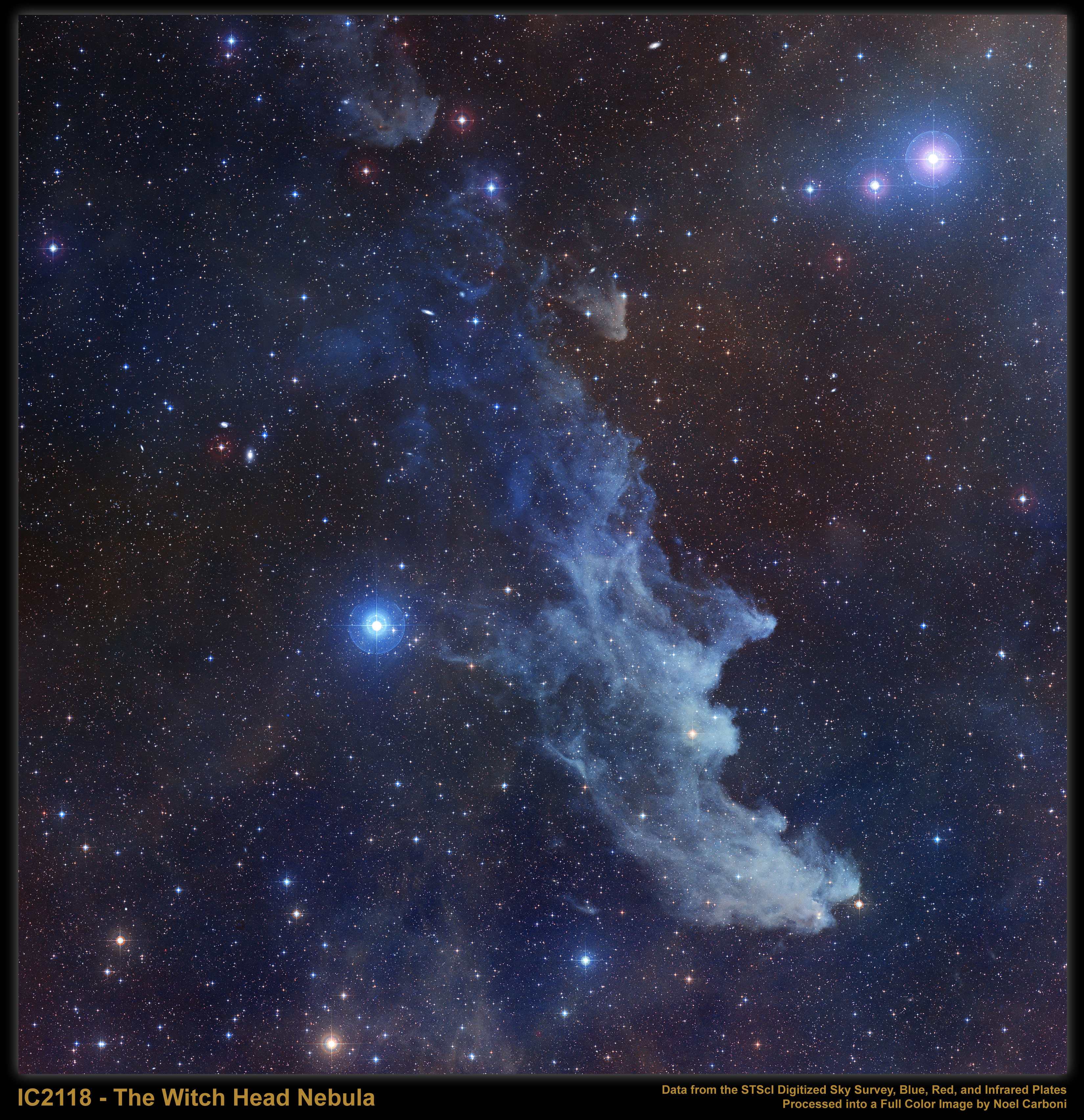
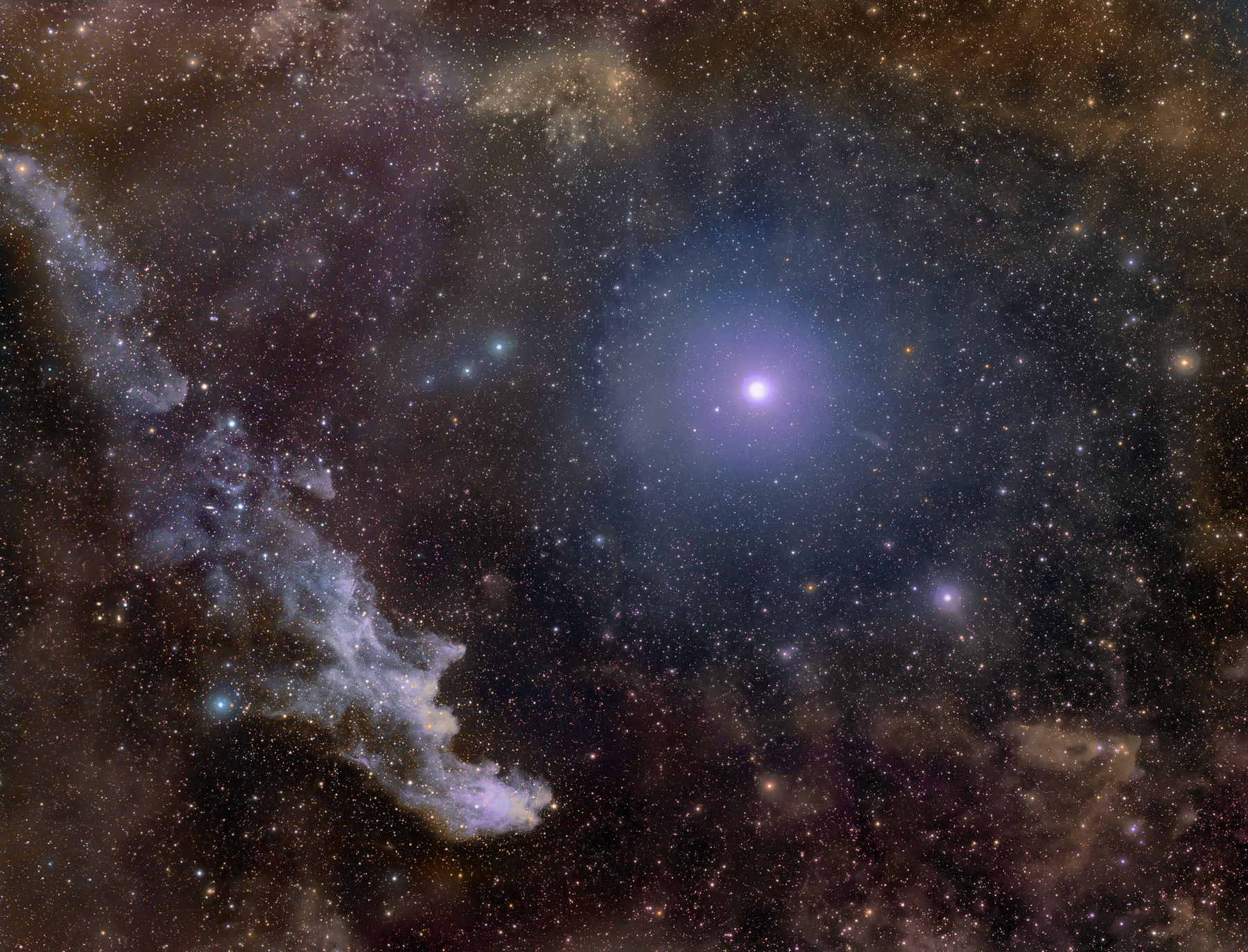
Witchhead Nebula (IC2118) - Double, double toil and trouble; Fire burn, and cauldron bubble -- maybe Macbeth should have consulted the Witch Head Nebula. This suggestively shaped reflection nebula is associated with the bright star Rigel in the constellation Orion. More formally known as IC 2118, the Witch Head Nebula glows primarily by light reflected from bright star Rigel, located just off the upper right edge of the full image. Fine dust in the nebula reflects the light. The blue color is caused not only by Rigel's blue color but because the dust grains reflect blue light more efficiently than red. The same physical process causes Earth's daytime sky to appear blue, although the scatterers in Earth's atmosphere are molecules of nitrogen and oxygen. The nebula lies about 1000 light-years away. (you can find a cropped version here)

Ok, so there are the first 5 images, I hope that you have enjoyed them and at least saved one or two.  Please do browse around spacetelescope.org or hubblesite.org for more wonderful images from Hubble.  Don't forget to check out the 2 high res shots of the hardware as well! 

I will be following this post up with another 5 images soon.  In the meantime, please feel free to tell me which are your favorite images, either from this list, or perhaps something I have missed.  Maybe it will make my next 5!